

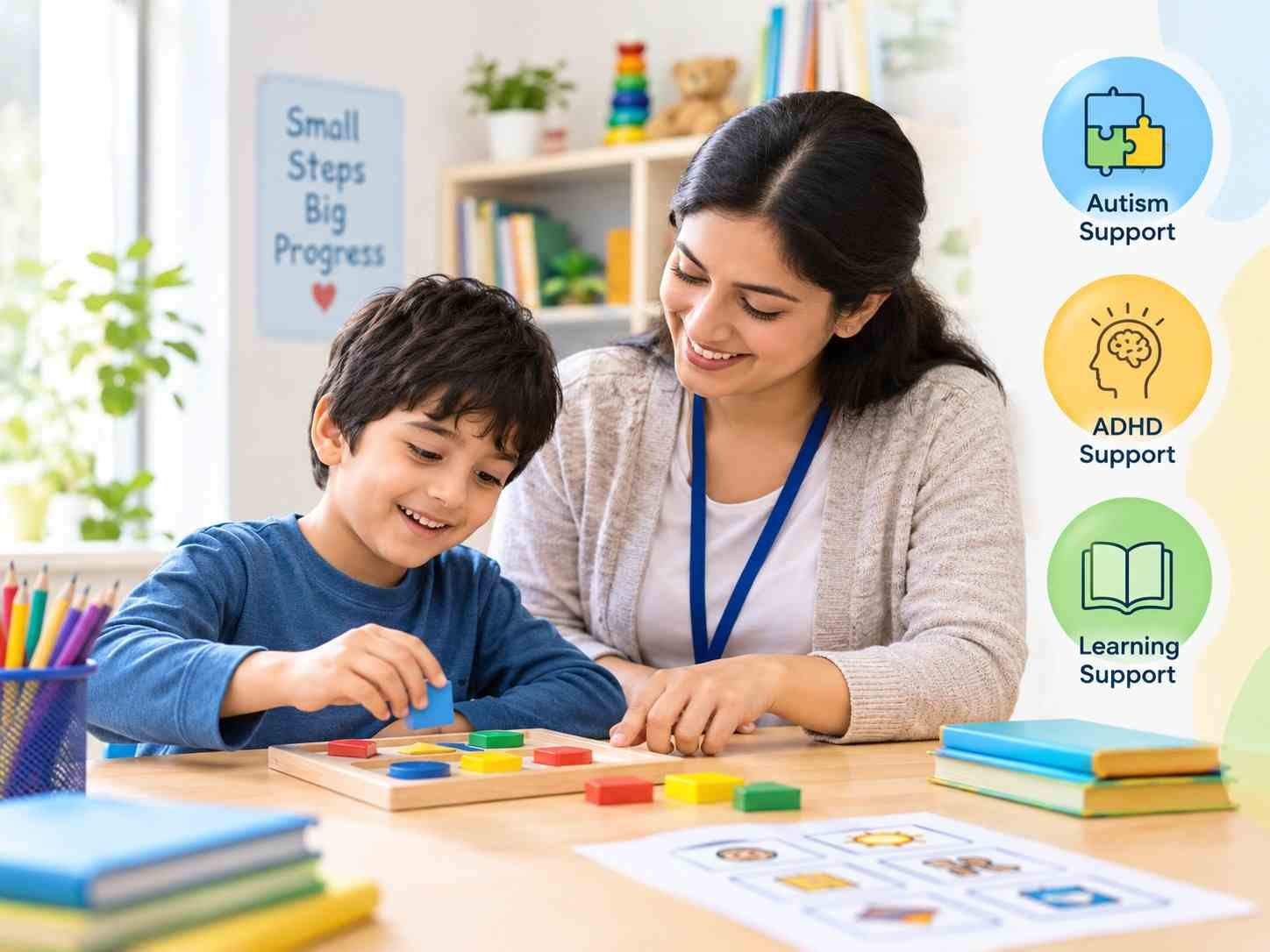
Every child learns differently. While some children adapt easily to conventional classroom teaching, others may need additional guidance to understand concepts, stay focused, communicate their needs, or complete everyday learning activities. Children with autism, ADHD, and learning difficulties may require a more personalized approach that considers their individual strengths and challenges.
This is where Special Education for Children can make a meaningful difference. With structured teaching, individualized goals and consistent support, children can develop academic abilities along with communication, social and independent living skills. The aim is not to compare children with their peers but to help each child progress at their own pace.
What Is Special Education for Children?
Special Education for Children is an educational approach designed to support children who experience difficulties with learning, attention, communication, behaviour, or developmental skills. Teaching methods and activities are adapted according to the child’s individual requirements.
A Personalized Approach to Learning
Instead of using the same teaching method for every child, special education may involve:
- Individualized learning activities
- Step-by-step instructions
- Visual and activity-based teaching
- Repetition and practice
- Structured routines
- Regular progress assessment
This approach can make learning easier to understand and help children become more comfortable participating in educational activities.
How Special Education Supports Children with Autism
Children with autism may be different in their learning profile. There are some who may have difficulties in social interactions and communication. Some may experience difficulties communicating and social interaction, while others might find the changes in routines, classroom instructions, or group activities challenging.
Creating Structure and Predictability
Special education for autism can provide a structured learning environment where children know what to expect. Visual supports, simple instructions, repetition, and activity-based learning can be used according to the child’s needs.
For instance, a complex task could be broken down into smaller parts. This will aid the child in understanding what is required and not feeling overwhelmed. Educational support could also concentrate on social interaction, communication, as well as academic and functional abilities.
The most effective approach is one that recognizes the individual child’s abilities instead of following a fixed method for every child with autism.
Supporting Children with ADHD Through Special Education
Children with ADHD may understand a lesson but struggle to maintain attention, organize their work or complete tasks. Long instructions and repetitive activities can sometimes make learning more challenging.
Making Learning Easier to Manage
Special education for ADHD can use shorter instructions, structured routines, focused activities, and manageable tasks. Larger assignments can be divided into smaller sections so children can concentrate on one step at a time.
A special educator may also help children develop organization, task-management and self-monitoring skills. Instead of focusing only on a child’s difficulties, the approach encourages them to understand how they can manage learning more effectively.
With regular practice and encouragement, children can gradually improve their participation and confidence.
Supporting Children with Learning Difficulties
Learning difficulties may affect reading, writing, spelling, mathematics, comprehension or information processing. A child may perform well in one area but require additional support in another.
Identifying Individual Learning Needs
Effective learning disabilities support begins with understanding where the child is struggling. Once these areas are identified, educational activities can be planned around specific skills.
For example, a child experiencing reading difficulties may need structured reading practice, while another child may need additional support with mathematics or written expression.
Special Education for Children provides an opportunity to focus on these individual needs while also building on the child’s existing strengths.
Importance of an Individualized Education Plan
Every child has different educational requirements. An Individualized Education Plan (IEP) can help establish clear learning goals based on the child’s current abilities and areas requiring support.
Setting Clear and Achievable Goals
A personal plan can comprise academic, communication and social goals as well as behavioural, social or even functional objectives. The progress can be analyzed frequently, allowing teachers and parents to know what’s working and what modifications may be needed.
This approach makes educational support more focused and gives families a clearer picture of their child’s development.
Role of a Special Education Teacher
A special education teacher assists in determining the best teaching methods in light of a child’s educational profile. The teacher can use individualized tasks, exercises that are practical, guided routines, and visual training to help students grasp.
Working With Parents
Parents play a crucial role in the process of learning. Communication between parents and teachers helps to ensure consistency between home and school activities. If children are supported in the right way in both their environments, children might find it easier to develop and use their abilities.
Building Confidence Beyond Academic Learning
The benefits of Special Education for Children are not limited to school performance. Progress may also involve better communication, improved attention, greater independence, social participation or the ability to complete everyday tasks.
Celebrating Individual Progress
Little achievements can have a significant influence on confidence of a child. If children are given positive reinforcement and encouragement rather than constant comparing and criticism, they are more willing to try new tasks.
The goal is to help children recognize their abilities and gradually become more independent learners.
Choosing the Right Educational Support
Finding suitable educational support starts with understanding a child’s individual needs. Parents should consider an environment that offers personalized learning, clear goals and regular progress monitoring.
Families looking for a special education centre in Uttam Nagar can explore individualized educational support based on their child’s requirements. Children who need additional communication support may also benefit from Child Speech Therapy in Tilak Nagar.
At Ekam the Child Development Centre, Special Education for Children is a focus on helping children suffering from Autism, ADHD, or learning issues learn academic and social abilities as well as functional skills. Through patient guidance and individualized instruction, children can move toward greater confidence, participation, and independence.